The celestial pole offsets (dψ, dε) give the offsets in longitude dψ and in obliquity dε of the celestial pole with respect to its position defined by the conventional IAU precession/nutation models. Their accurate determination from VLBI observation started in 1984. Herebelow they are referred with respect to the former precession-nutation model (IAU 1980) :
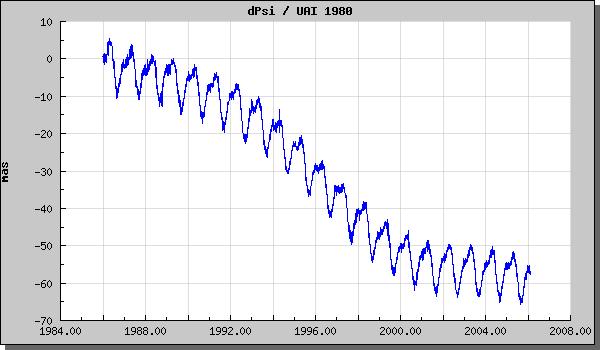
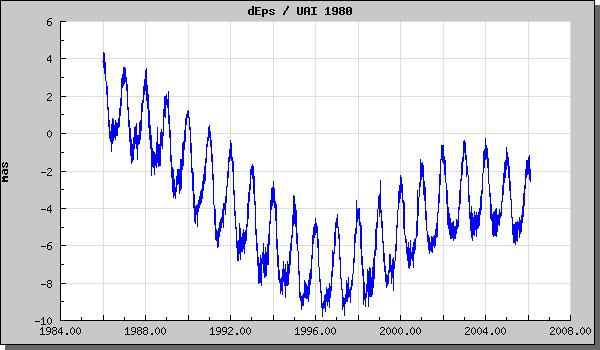
Figure 1 :Celestial pole offsets: motion of the celestial pole relative to the IAU 1980 Theory of Nutation ant the IAU 1976 Precession. Unit: mas (0.001")
The observed variations, displayed on Fig. 1, reflect the difference of the actual celestial motion of the pole with the one predicted by the conventional IAU 1980 precession and nutation models. Most of these variations are explained by errors in a few terms of the IAU models: secular term, periodic terms (mainly 18.6, 1.0, 0.5 years and 14 days). These terms are well modelled in the present precession-nutation model IAU 2000.
IERS 2000 CONVENTIONAL NUTATION MODEL : IAU 2000
According to the IAU 2000 recommendations, users should make use of the conventional model UAI 2000. The celestial pole offsets (dψ,dε) referred to "IAU 2000 A" are then reduced to values below 1 mas. Meanwhile a new parametrisation of the celestial pole offsets has been recommanded, based on the non rotating origin formalism of the Earth orientation matrix : these are (dX,dY), corrections to the coordinates in the ICRF of the "Celestial Intermediate Pole" ( = "Celestial Ephemeris Pole" accuratly defined for the diurnal and subdiurnal variations of the EOP). The transition from (dψ,dε) to (dX,dY) or inversely can be achieved by the accurate relation, written in the chapter 5 of the IERS 2000 conventions (programmation in uai 2000 package ; see readme here) proposed by the EOP center) or by using the approximation (error below 1 microarcsecond over 1980-2020):
dψ sin ε0= dX
dε = dY
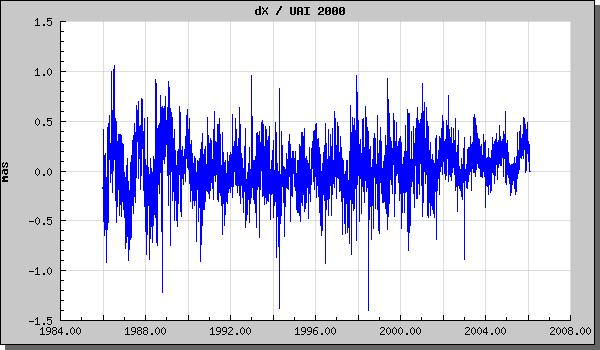
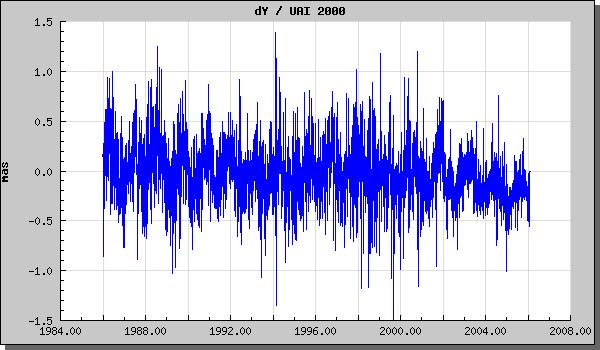 Figure 2: Celestial pole offsets dX/dY referred to IAU 2000 precession-nutation model. Unit : mas (0.001"). The IAU 2000 precession-nutation model matches the observations within +/- 0.001".